Oct. 29, 2026 | By Elaine Sanchez, Defense Health Network Central



Oct. 29, 2026 | By Elaine Sanchez, Defense Health Network Central
SAN ANTONIO, Texas — When a local resident suffered a heart attack at a local pickleball facility, bystanders immediately sprang into action to render aid before emergency medical services arrived.
Among those bystanders was Gary Rondeau, a retired U.S. Air Force firefighter and EMT, who now serves as the medical emergency manager for the military medical treatment facility at Barksdale Air Force Base.
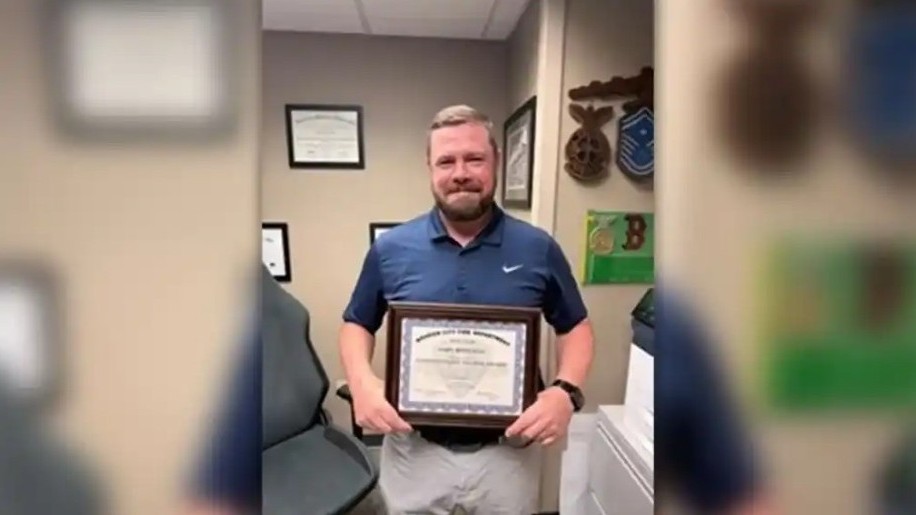
The life-saving intervention recently earned Rondeau and other bystanders the Bossier City Fire Department’s prestigious "Life Saving Award” — marking the first time the department had presented the award in 15 years. "My initial reaction to hearing it was the first time this award was presented in 15 years was shock," Rondeau said. "When you step in to help, you aren’t thinking about recognition — you are just focusing on the person in front of you and relying on your training. To learn that our collective efforts marked such a rare milestone for the Bossier City Fire Department is deeply humbling.”
Seconds Count Across the Courts
The emergency unfolded on July 8 at an indoor pickleball facility in Bossier City. Rondeau was playing a match in one building when Bruce Poynter collapsed in an adjacent building on the property.
A player sprinted into the building where Rondeau was playing, frantically shouting for a doctor. Recognizing the signs of an active cardiac arrest, Rondeau vaulted a fence and ran out the door toward the adjacent building.
Upon arrival, he found Poynter unresponsive on his back, surrounded by bystanders attempting to render aid. Dr. Sean Patel, a local dentist, was performing chest compressions, while Dylan Fauver, who reached Poynter first, had initiated CPR and was administering rescue breaths. Coincidentally, Patel had recertified his CPR training that morning, according to news reports.
Rondeau immediately asked a facility employee to locate an automated external defibrillator, AED. "When I got to Mr. Poynter, I felt for a pulse and there wasn’t one present," he recalled. As Patel finished his round of compressions, Rondeau stepped in to take over the chest compressions while Favor continued rescue breaths.
The rescue quickly became a test of resourcefulness and coordination. While facility employees rushed to secure an AED, Rondeau and Fauver continued manual CPR without interruption to maintain blood flow.
After several more rounds of CPR, the AED arrived, and by this time, a Bossier City police officer was on scene. Another bystander stepped in to assist with CPR efforts, while the officer applied the pads and delivered a shock. "He had a weak and thready pulse at this point, but not enough to sustain life on his own," Rondeau said.
When paramedics arrived, Rondeau continued manual CPR while the EMS crew prepared a mechanical chest compression device. Once the device was ready, Rondeau assisted the crew in transferring Poynter onto a gurney and wheeling him out to the ambulance.
A Community Chain of Survival
“Immediately following the incident, I went home and spent the next 24 hours just hoping and wondering if I did everything I could,” he said, a worry he recalled from his years in the fire service.
The answers came a week later when Rondeau returned to the pickleball facility. A woman ran up to him and told him Poynter was back and eager to meet him. "I was shocked to see him standing there with his wife," Rondeau said. "He looked incredible, said he felt incredible, and has no lasting effects from the heart attack."
Meeting the man he helped save also brought a moment of shared humor. "The first thing he said to me was, 'I hear you’re the reason my chest and ribs are so sore,'" Rondeau said. "I said, 'Yeah, I may have had something to do with that.'"
Reflecting on the encounter, Rondeau noted how rare such closures are for first responders. "So often in emergency response, you never get to know the final outcome," he said. "You do everything you can during the window you have the patient, hand them off to definitive care, and hope for the best. It really was amazing to see this one come full circle."
While Rondeau has received significant praise for his role in the rescue, he emphasized that Poynter's survival was the direct result of an unbroken "chain of survival" executed by community members. "There were people holding doors, getting AEDs, calling 911, directing police and EMS, even one lady who was wiping Mr. Poynter’s mouth before every rescue breath to ensure Dylan could easily perform mouth-to-mouth resuscitation," Rondeau said. "If any of the people helping in their own way were removed from the situation, the outcome may have been drastically different."
The Standard of the 'MED' Tab
The presentation of the Life Saving Award during a Bossier City Council meeting highlighted the vital role bystanders can play before ambulances arrive.
For Poynter, who was present at the city council meeting to see his rescuers honored, the experience was a profound realization of the importance of bystander intervention. Within two weeks of surviving the heart attack, both Poynter and his wife both became CPR certified. "Healthcare providers are often the first line of defense when a life is at risk," Poynter said. "Gary’s preparation, competence, and quick response saved my life. CPR certification is a commitment to being prepared when every second counts, and I am thankful every day that Gary took it seriously."
Col. Salvador Vargas, Barksdale Medical Group commander and MTF director, commended Rondeau’s quick thinking and selfless service. “Gary’s heroic actions are a powerful testament to the lifelong value of military medical training,” Vargas said. “His ability to remain calm, take charge in a chaotic environment, and deliver exceptional care reflects the very best of our medical professionals.”
“We are fortunate to have someone of Gary’s experience, talent, character, and caliber within the Barksdale Medical Group,” he added. “He is an invaluable asset to the medical enterprise and the United States Air Force, and his team-first, can-do mindset makes him an outstanding leader for our medical emergency management team.”
For Rondeau, the rescue serves as a direct message to the broader military health communities. During a recent newcomers’ briefing for personnel arriving at Barksdale AFB, Rondeau reminded personnel of the profound public trust symbolized by their uniform. "I told them to remember that when they are walking around base, everyone sees that 'MED' tab on their sleeve," Rondeau said. "The public assumes everyone wearing that tab is ready and trained to provide life-saving aid at a moment’s notice. If the time comes when someone needs that aid, you better be ready to prove them right."