

Oct. 15, 2026 | By Kevin Larson, Winn Army Community Hospital


From about 6-7 p.m. ET, DHA.mil will be unavailable while we undergo routine maintenance.

Oct. 15, 2026 | By Kevin Larson, Winn Army Community Hospital
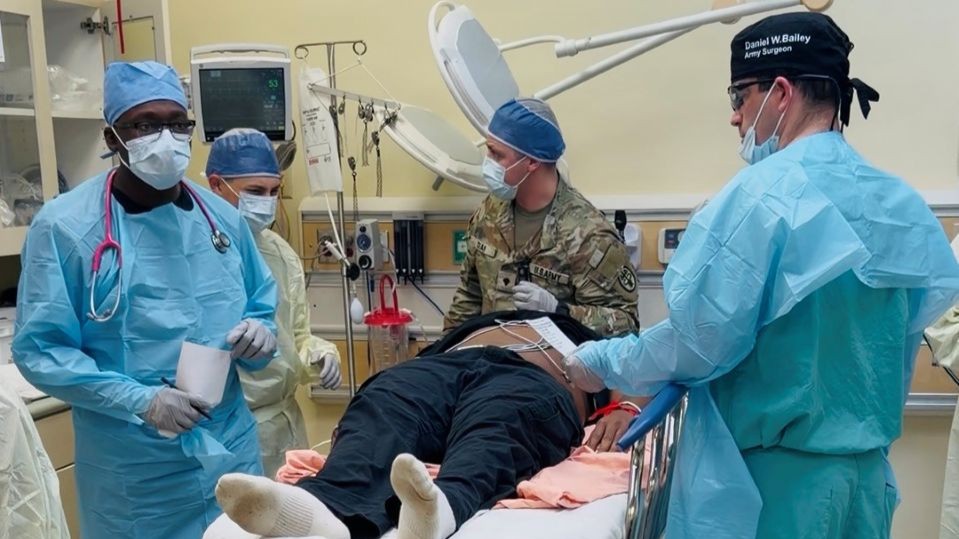
Quiet, controlled chaos. That was the scene in Winn Army Community Hospital’s emergency department on Oct. 14 in the late morning as several simulated victims poured through the ambulance bay doors in the wake of a simulated drone attack at Fort Stewart’s Soldier Service Center.
Oxymorons aside, the team assembled in Winn’s ER—composed of nurses from primary care, radiology technicians and students, surgeons, dedicated ER staff, and more—was calm and ready to care for casualties as soon as the alert went out that wounded were incoming.
Nurses from the ER staff quickly briefed their primary care colleagues and others on the plan, outlining which rooms would take which patients. Supplies, wires, respirators, gurneys, and other medical equipment were positioned and prepared. Teams were formed and assigned to each room.
Along with clinical personnel, patient administration sent its intake team to the ER’s ambulance bay to ensure every casualty was entered into the tracking system and had the necessary document packet provided to facility medical care. Working together, admin and ER staff cross-checked the packets to ensure critical forms like lab orders and others were included.
With everyone now prepared to receive the casualties, a hush fell over the ER as the team waited for the first ambulance to arrive. Moments later, two Fort Stewart ambulances pulled into the bay. And patient care began. Simultaneously, off post in Hinesville, Liberty Regional Medical Center also swung into action, taking in 10 patients to test inter-facility communications and regional surge capacity.
At Winn, admin staff sprang into action, going patient to patient while paramedics unloaded them, asking for personal information. Triage teams also moved in, assessing the wounds and determining where in the ER each patient would go. Two walking wounded were led to smaller patient care rooms where their wounds were treated. Two more seriously injured were brought into the higher care rooms—one into trauma, the other into resuscitation. Three patients were wheeled into the ER’s open bay.
Assessments, interventions, and orders for imaging and more were being made for each patient. Doctors determined which needed immediate surgery, which needed transfer to higher levels of care, and which were stable enough to hold while the more seriously injured were in the operating room.
For LRMC CEO R. Derek Rozier, participating in the exercise means being a good neighbor while sharing a mission to treat the wounded by establishing trust in and understanding of capabilities and organization between the hospitals. “Fort Stewart’s soldiers and families are part of the community we serve,” Rozier said. “Participating in exercises with Winn Army Community Hospital and our other community partners helps us prepare together for emergencies that require a coordinated response. These exercises allow us to practice communication, coordinate patient care and transfers, and identify opportunities to improve our readiness.”
Once the determination was made that no additional casualties were arriving at Winn and the medical process had run its course for each patient, the exercise finished.
With the exercise concluded, the surge team stood down, and the ER resumed its routine operations. Systems and processes were tested and evaluated, and unity of effort across Winn’s teams was achieved. Jeni Davis, the charge nurse in the emergency room during the exercise, said that was the most notable outcome of the exercise. “I’m incredibly proud of our team and the way we came together to take care of the patients,” she said. “I’m also very thankful for the staff and the rest of the hospital that came down to assist us.”
While working well together across disciplines and clinics was key, Davis also said strong leadership directing the teams led to success. That success is crucial if a real-world event occurs and points to why exercises are valuable. “When a real event happens, which is going to happen, we’re prepared and ready to execute our protocols without delay,” Davis said.
Col. Alex Montgomery, hospital director and Fort Stewart Medical Department Activity commander, echoed the importance of being prepared, not only internally to Winn, but externally with partner hospitals. Readiness is a team effort that crosses Fort Stewart’s gates, he said. “Our staff did an outstanding job managing the patient flow locally while coordinating seamlessly with Liberty Regional Medical Center,” Montgomery said. “Receiving casualties into our ER while coordinating regional transfers allowed us to stress-test our systems in real time and gave us invaluable data on how we hold up during a surge. Every exercise is an opportunity to improve our processes—by sharpening those mechanisms now, we ensure we are fully prepared to support our warfighters and community when seconds truly count.”


