Sept. 25, 2026 | By Douglas Holl, Defense Health Agency-Public Health Communications


Sept. 25, 2026 | By Douglas Holl, Defense Health Agency-Public Health Communications
The Department of War has expanded its mental health protection efforts to save lives, a proactive focus that aligns with a newly reported drop in military suicide deaths. According to DOW’s Annual Report on Suicide in the Military for Calendar Year 2024, deaths fell from 531 in 2023 to 471 in 2024.
Kirsten Anke, a public health nurse with Defense Health Agency-Public Health at Aberdeen Proving Ground, Maryland, said the military continues to use a comprehensive public health approach to routinely monitor and mitigate risk factors while providing a full continuum of care. To support this proactive shift, leaders and researchers look closely at real-world data and the daily stressors that impact service members.
"Our understanding of suicide has grown," said Anke. "We don't view suicide as an isolated event anymore. It's a complex public health issue with deep social and environmental roots."
The Defense Suicide Prevention Office, or DSPO, report shows that the Total Force suicide rate was 23.2 per 100,000 service members in 2024. Most of the service members who died by suicide in 2024 were enlisted males under the age of 30, representing 56% of Total Force deaths.
Behind these numbers are real-life challenges. The report shows that among active-duty service members who died by suicide, 45% had intimate relationship challenges, and 34% faced workplace difficulties. Another 24% had dealt with administrative or legal actions within the previous year.
“While these circumstances are associated with heightened vulnerability, suicide risk rarely stems from a single experience or stressor,” said Army Maj. Michelle Worsley, a DHA-PH licensed clinical social worker at APG. “Instead, it reflects the complex interaction of personal, social, and occupational stressors over time.”
Just as critical as identifying these risk factors is recognizing the protective factors that fight against them, said Worsley. Strong connections with family, peers, and leaders, a clear sense of purpose, effective problem-solving skills, and timely access to physical and mental healthcare significantly strengthen resilience and serve as vital buffers. Establishing protective factors early on provides service members with the stability needed to navigate life’s challenges to avoid or prevent a crisis.
Worsley said leaders can build on many protective factors long before a crisis occurs. These include fostering trust, encouraging peer support, recognizing accomplishments, checking in on service members, promoting help-seeking, and creating psychologically safe environments where service members feel comfortable. While protective factors don’t guarantee that a service member will never experience thoughts of suicide, they can reduce vulnerability, increase a service member’s ability to cope, and provide reasons or opportunities to pause, seek support, and remain engaged during a crisis.
“Army leaders can also request a deskside from their installation’s Community Readiness and Resilience Integrator or Army Resilience Directorate who can either give them a direct training or connect them with resources that will,” said Worsley.
Worsley added that suicide prevention is one of the main jobs of the chaplain corps and leaders should lean on them heavily for training, education and outreach. “Suicide prevention is most effective when it becomes part of everyday leadership and readiness and not only as a response after crises,” said Worsley. “By intentionally building and maintaining protective factors, leaders can create an environment where service members feel supported, valued, and equipped to face challenges, all of which reduce the risk of suicide before a situation escalates.”
Worsley recommends leaders refer to the DSPO Leaders Suicide Prevention Safe Messaging Guide as a resource. In the guide’s introduction, DSPO says the purpose of the Leaders Safe Messaging Guide is to better equip leaders with the tools and resources necessary to safely and effectively communicate about suicide with service members, units, and military communities.
Worsley said leaders asking a service member, “Are you thinking about suicide?” does not put the idea in their mind. It actually shows that service members matter enough for someone to notice changes in them. It opens the door to honest conversations because now the leader has created a safe space and potentially saved a life, as some experiencing crisis want help but don't know how to ask.”
Worsley said leaders must remember to listen without judgment, and be mindful of not lecturing, threatening, or emphasizing career consequences during these conversations. “It’s important to model a culture where seeking and receiving treatment for mental healthcare are accepted and normalized,” said Worsley. “Leaders shouldn’t only discuss what resources are available, but also how seeking support can strengthen resilience, relationships, and overall well-being. If a service member feels safe with you because you’ve shown them you care, they are more than likely to go to you for assistance when in crisis.”
Guidelines from the DOW and Department of Veterans Affairs show that transitions are high-risk windows, said Traci Addison-Sarauw, a DHA-PH clinical social worker at APG. This includes permanent change of station moves or leaving the military. "When transitions pile up, vulnerabilities increase," said Addison-Sarauw. "Moves, breakups, or job changes can weaken social ties. This lack of support increases the risk for mental and social health struggles."
Addison-Sarauw encouraged service members to explore and strengthen their support networks to assist them in managing stressful events before they occur. “I have been privileged to speak with dozens of transitioned veterans and transitioning service members, and I think if there is one common theme I’ve heard from all of them, is that transition is different for everyone,” said Coop Hodges, a research psychologist with DSPO. “Whether you did a few years or are retiring from the Service, re-entering civilian life can be a monumental shift for many."
Hodges recommends service members start thinking and talking about transition early. “It’s never too early to start thinking about your future and what you want to do next,” said Hodges. “Talk with other veterans who have recently transitioned, get in touch with your local Transition Assistance Program, and don’t be afraid to ask for help.”
For clinical care, the Defense Health Agency's inTRANSITION program offers free and confidential coaching to help service members connect with new mental healthcare providers during their transitions. For nonclinical support, service members can contact Military OneSource at 800-342-9647. This program provides free relocation tools and confidential, nonmedical counseling to help manage relocation stress.
Another key focus for the DOW is lethal means safety. In 2024, firearms were the most common method of suicide, used in 66% of deaths across the Total Force. Also, 86% of these deaths occurred in the United States, with 38% happening on military installations.
"Safe storage of firearms and medications is one of our best safety measures," said Army Master Sgt. Jeffrey T. Gilbert, a combat medic specialist and operations noncommissioned officer in charge for the headquarters and headquarters company supporting Defense Centers for Public Health-Aberdeen at APG. "Research shows that the decision to attempt suicide is often very impulsive. It can last only five to 10 minutes. When people put time and space between a person in crisis and a lethal weapon, they directly disrupt that impulse."
Gilbert pointed to a study in the April 2026 issue of JAMA Network Open. The study showed secure firearm storage reduces suicide risks. Storing unloaded, locked weapons separate from ammunition saves lives. To make this easy, DOW and the Veterans Administration co-produced the Keep It Secure campaign to offer practical storage tips. Also, DOW’s Defense Suicide Prevention Office has partnered with USAA’s Face the Fight Foundation to support programs like PausetoProtect.org, which lets service members store firearms at local, off-base shops during tough times.
"When battle buddies or spouses notice a loved one is struggling, they need to have a supportive, nonconfrontational conversation about temporarily securing firearms," said Gilbert. "The conversation must come from a place of compassion, not accusation. It helps to frame the action as a temporary safety measure, like taking the keys from a friend who has had too much to drink."
During a calm and private moment, Gilbert suggested a supporter can step in. "A supporter can say, 'I know things are heavy right now, and I want to help you through this by holding onto the gun safe keys for a bit.' This approach reduces friction and limits access to lethal means without threatening the individual’s ownership of the firearms," said Gilbert.
A major barrier to seeking care is the fear that asking for help will damage a military career or security clearance. Leaders are working hard to stop this myth. According to the Defense Counterintelligence and Security Agency, seeking help is a positive step. It shows sound judgment and reliability. Seeking mental healthcare is not a reason to deny or revoke a security clearance.
DOW Instruction 6490.08, “Command Notification Requirements to Dispel Stigmas in Providing Mental Health Care to Service Members,” gives provisions for privacy protection for service members using mental healthcare resources and identifies situations when command notification is required. In those cases, mental healthcare providers only disclose the minimum amount of necessary information.
For those who want a direct and confidential path to care, the Brandon Act is now law. This law honors Navy Petty Officer 3rd Class Brandon Caserta, who died by suicide in 2018. Congress passed the law in 2021. The Brandon Act lets service members seek help confidentially for any reason, at any time, and in any environment. It allows them to request a referral for a mental health evaluation through any supervisor in the grade of E-6 or above, ensuring they get care quickly and privately.
“Frankly, I’ve heard junior service members being told by their leadership to reschedule mental health appointments because the service members are needed for other duties,” said Worsley. “Leaders need to make expectations clear that mental health appointments are legitimate readiness requirements, and patterns of increased cancellation, obstruction, or stigmatizing treatment should be addressed immediately.”
Gilbert said it’s also important for leaders to look for signs a service member may need help. "If leaders notice a battle buddy showing signs of withdrawal, sudden irritability, or a disheveled appearance, they should not wait," said Gilbert. "Engage them privately. Frame safe storage as a temporary safety measure. Work together to keep each other safe."
By checking in on each other, reducing access to lethal means, and promoting early care, the military is protecting its service members and preserving its mission readiness. “Every interaction a leader has with a service member is either strengthening or weakening protective factors,” said Worsley. “Suicide prevention isn’t a single conversation. It is a cumulative effect of everyday leadership.”
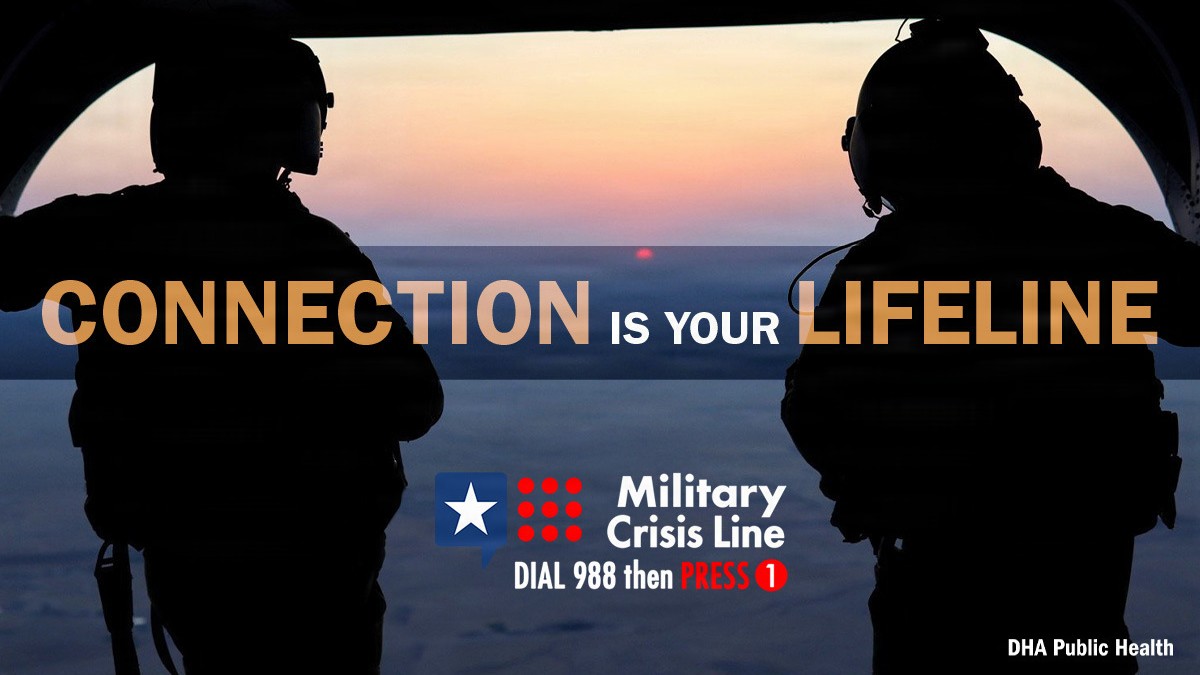
If you or someone you know is in distress or is experiencing a mental health crisis, free and confidential support is available 24/7:
The Defense Health Agency is a Combat Support Agency, serving as a force multiplier for the joint services by optimizing lethality through warfighter medical readiness.
NOTE: The mention of any non-federal entity and/or its products is for informational purposes only, and is not to be construed or interpreted, in any manner, as federal endorsement of that non-federal entity or its products.