Sept. 24, 2026 | By Regena Kowitz, Defense Health Network Pacific Rim



Sept. 24, 2026 | By Regena Kowitz, Defense Health Network Pacific Rim
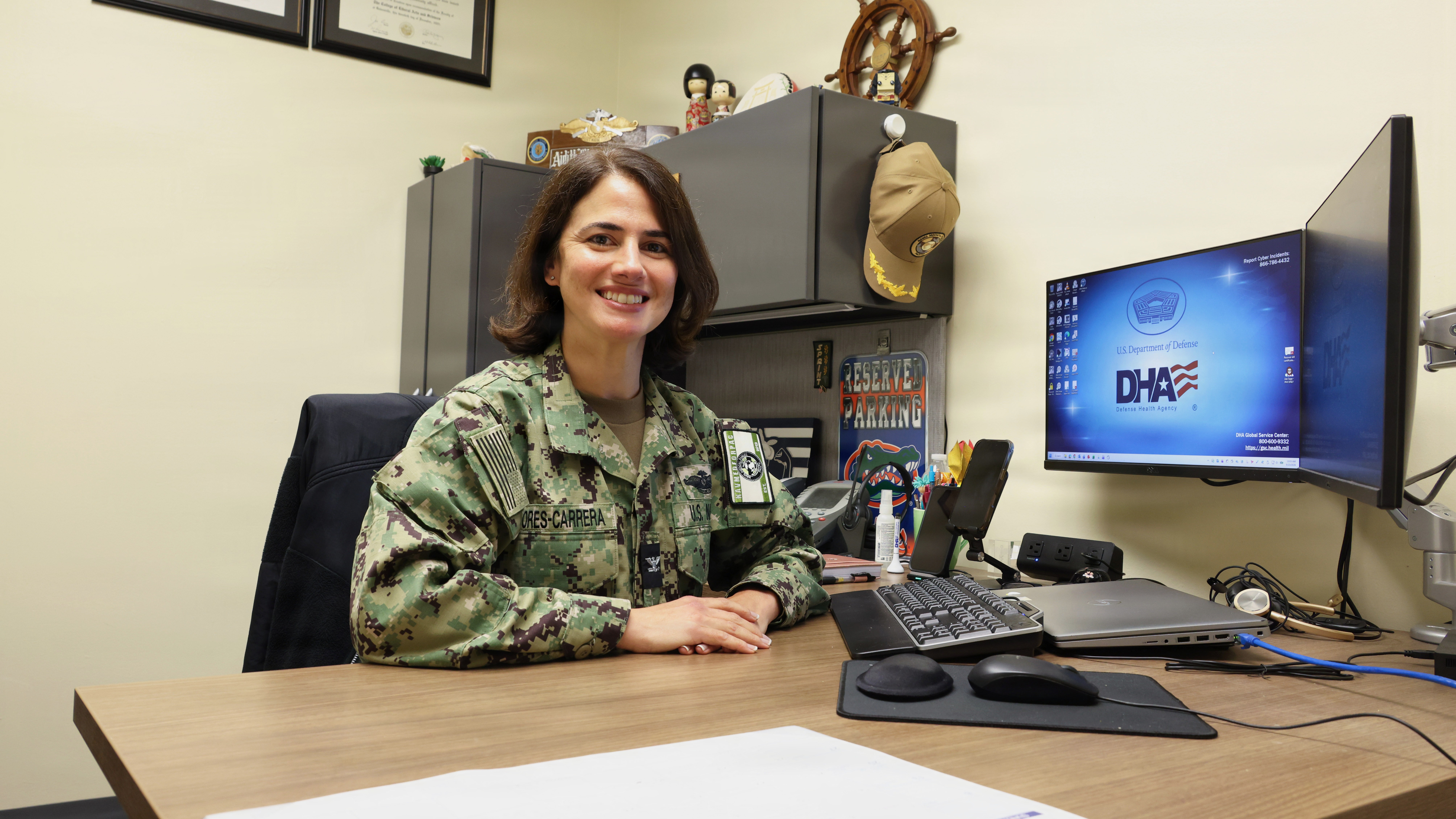
SAN DIEGO, Calif. — Early in her career, Navy Capt. Aidith Flores-Carrera sat down with a junior enlisted Sailor who arrived exhausted and convinced their career was over. Severe anxiety and insomnia had taken hold, and the Sailor had decided that was the end of the story.
It wasn’t.
“Through a structured care plan combining sleep hygiene, therapy coordination, and brief medical support, they regained full function, completed a successful deployment, and advanced in rank,” Flores-Carrera said. “Seeing someone reclaim their purpose is why this specialty matters.”
Flores-Carrera is an active-duty Navy psychiatrist, the senior mental health executive for Naval Medical Forces Pacific, and the mental health lead for Defense Health Network Pacific Rim, which spans nine military hospitals and clinics across the U.S. West Coast, Guam, and Japan.
A native of Miami, Florida, she joined the Navy because she wanted “to practice medicine where the mission transcends the individual — caring for warfighters, deck plate leaders, and the families who sustain them across operational environments.”
That dual identity as both a naval officer and a physician gives her a distinct advantage when treating active-duty patients. “Wearing the uniform bridges the gap,” she explained. “I understand the operational tempo, chain-of-command dynamics, and mission expectations firsthand, which helps me deliver practical, context-aware clinical care.”
That commitment to the collective mission is why, during Suicide Prevention Awareness Month, she wants service members to know that staying in the fight isn’t just about crisis hotlines; it’s about embracing routine mental health care as a vital part of staying medically ready and mission capable. “Taking care of your mind is taking care of your mission,” she said. “Seeking support is not the end of your story. It is how you sustain your career, protect your family, and remain ready.”
Maintenance, not repair
One of the Defense Health Agency’s top priorities is warfighter medical readiness, and mental health care is part of that readiness. Seeing a psychiatrist should feel as ordinary as seeing a primary care provider for an annual physical or an orthopedic surgeon for a bad knee. Flores-Carrera frames her own work the same way: force health protection, delivered early enough to keep a manageable problem from turning into lost duty days. “If an athlete feels a hamstring pull, they see physical therapy immediately to prevent a full tear,” she said. “Mental healthcare operates under the exact same principle. Addressing operational wear-and-tear early prevents acute clinical crises and keeps service members deployable.”
That early window matters more than most people realize. Addressing distress while it is still mild, she said, preserves coping reserves and allows for brief, low-impact adjustments rather than a long recovery after performance has already slipped.
Psychological fitness also affects team performance. Flores-Carrera said it sharpens cognitive agility, decision-making under stress, situational awareness, and crew cohesion, all of which affects how a team collectively meets their mission. Ultimately, maintaining individual mental health early is what prevents a breakdown in a unit’s overall readiness before they ever step into harm's way.
What a psychiatrist actually does
One of the most persistent barriers to seeing mental health care is a misunderstanding of the specialty itself. "Many believe seeing a psychiatrist automatically means medication or immediate duty disqualification," Flores-Carrera said. “In reality, psychiatry is a collaborative specialty focused on a comprehensive medical, biological, and psychosocial evaluation to restore function and optimize quality of life.”
Psychiatrists are physicians. They evaluate the biological and physiological pieces of mental health, including sleep, neurochemistry, underlying medical conditions and medication interactions, and they work alongside psychologists, social workers, counselors and primary care managers. Many, including Flores-Carrera, provide psychotherapy themselves.
The first appointment is a 45- to 60-minute conversation covering medical history, occupational demands, lifestyle, current symptoms and personal goals. What follows is built together. “Care is never one-size-fits-all,” she said. “We use shared decision-making. I present evidence-based options, discuss benefits, risks, and operational impacts, and together we establish goals tailored to your individual values and readiness requirements.”
Medication, when it’s part of the plan, is one tool among several that can include psychotherapy, sleep optimization, exercise, mindfulness, and peer support. She is also direct about the career question, because worry over what a visit might do to a clearance or an assignment can keep someone from seeking help. “The biggest myths are that seeking care ends careers, revokes security clearances automatically, or labels an individual as ‘broken,’” she said. “In truth, the vast majority of personnel receiving outpatient mental health care retain their clearances and continue successful military careers.”
Knowing when to check in
Flores-Carrera pointed to a short list of indicators that signal operational stress or declining mental fitness worth paying attention to, in yourself or in a shipmate: persistent sleep disruption, loss of interest in hobbies, escalating irritability or anger, pulling away from shipmates or family, trouble concentrating, or leaning on alcohol to cope. Recognizing these changes early is key to mental fitness and a problem also doesn't have to be severe to be worth a conversation. “You do not need to be in crisis to deserve support,” Flores-Carrera said. “If an issue is occupying your mental bandwidth, impacting your sleep, or affecting your relationships, it is significant enough to discuss.”
Routine conversation is what makes that possible. “Normalizing discussions around sleep, family transitions, and fatigue removes shame,” she said. “When talking about life friction is standard, minor issues are resolved before they compound into operational hazards.”
Flores-Carrera said leaders set the climate when they share their own experiences with routine care, make appointments easy to get to, and check in on their people out of genuine curiosity rather than administrative scrutiny.
Asking the question
Suicide Prevention Awareness Month, in Flores-Carrera’s view, is an institutional checkpoint to re-anchor on connectedness, peer support, and early intervention at every level of command. Most of that work is ordinary and daily such as greeting shipmates by name, noticing when someone's baseline changes, and listening.
When something seems off, she recommends pulling the person aside somewhere private and low-threat and use direct, observable statements to communicate. “I've noticed you seem like you’re carrying heavy stress lately and you’ve been quiet,” she offered as an example. “How are you really doing?”
Then ask the real question, without hedging, using the ACE model: “Are you thinking about suicide?” or “Are you having thoughts of wanting to end your life?”
“Asking directly does not plant the idea,” Flores-Carrera said. “It provides immense relief.”
If someone is in immediate danger, she said, never leave them alone. Secure lethal means immediately, escort them to the nearest military treatment facility emergency department, contact command leadership or security, or call 911 or 988.
A pathway forward
Support is available through the 988 Suicide and Crisis Lifeline, press 1 for the military and veterans; unit chaplains, who offer 100 percent privileged communication; Military OneSource at 1-800-342-9647; and mental health clinics at hospitals throughout the Military Health System.
Flores-Carrera’s closing message is for anyone who is struggling right now. “You do not have to carry this weight alone, and the pain you are experiencing right now is treatable,” she said. “Crisis is temporary, but reaching out creates an immediate pathway forward. There are people trained and ready to stand with you.”
Defense Health Network Pacific Rim is one of the Defense Health Agency’s nine networks of hospitals and clinics that deliver high-quality health care to more than 140,000 enrolled beneficiaries, supporting major operational units through the Indo-Pacific. The DHN-PR headquarters is located in San Diego, overseeing military hospitals and clinics along the U.S. West Coast and overseas in Guam and Japan.