July 29, 2026 | By Douglas Holl, Defense Health Agency Communications


July 29, 2026 | By Douglas Holl, Defense Health Agency Communications
U.S. Public Health Service Capt. Sara Newman has taken the helm as the new director of Defense Health Agency-Public Health. Bringing more than 30 years of public health experience, Newman is dedicated to ensuring that service members are fit, resilient, and ready.
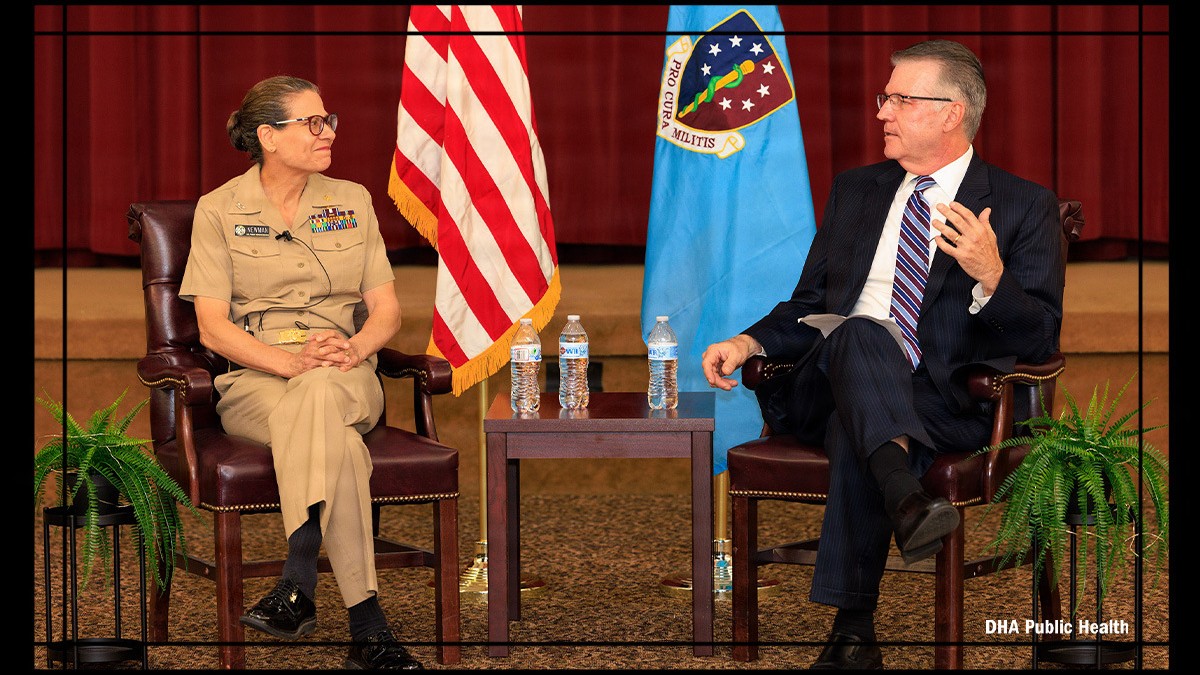
Newman’s career spans academic research, emergency response, infectious disease control, and environmental health. In a series of recent engagements, including a direct interview and a staff town hall held June 25 at the Defense Centers for Public Health–Aberdeen at Aberdeen Proving Ground, Maryland, she shared her strategic vision for the agency, her personal journey, and her dedication to the public health workforce.
From public lands to force health protection
Newman’s connection to the outdoors and nature was forged during her childhood. Growing up, her family camped extensively, eventually buying a Volkswagen van and traveling across the United States. These formative experiences of sleeping under the stars instilled in her a lifelong appreciation for the outdoors. While serving in her former position as the director of the Office of Public Health for the National Park Service, Newman highlighted this connection in a national campaign video introducing free park access for military families. In that former role, Newman described public lands as vital therapeutic resources, noting that national parks serve as "places of healing, reflection, and rebuilding resilience" for those recovering from the physical and mental wounds of war.
Newman emphasized that providing gold star families and veterans free, lifetime access to our national treasures is "a small token of a nation's eternal gratitude to those who have sacrificed the most."
Now at the DHA, Newman wants to use military installations to promote physical fitness and mental health, helping service members prepare for when the call comes. During her recent town hall, she explained how environmental wellness directly overlaps with readiness.
"Our secretary of the Department of War values fitness, health, and readiness," said Newman. "If you're not fit, if you're smoking, if you're not eating right, if you're not getting enough sleep — you're not as ready as you need to be. Because when that call comes, you need to be very, very ready. That's our job."
Newman’s passion for the outdoors is also a core family value. During her town hall address, she recalled taking her daughters hiking when they were younger, and the resistance she sometimes faced. "I remember them kicking and screaming about having to go hiking," Newman laughed. "Because, you know, kids today would rather be inside on their phones and with their friends playing games, and I'm like, 'No, you're going outdoors; you're hiking.' Once they were out there, they loved it."
She shared a touching memory from years later that reinforced the lasting impact of that connection. "I was with my daughter when she was 18, about to graduate, and we went on a hike," said Newman. "We were eating peanut butter and jelly right up at the top, and she said, 'Mommy, thank you for making me go outdoors, and I'm so sorry that I gave you such a hard time. I don't know what I'd do if I didn't have this, if this weren't part of my life.'"
Grounding public health policy in practical science
Newman believes that data must drive our decisions. Early in her career with the Federal Bureau of Prisons, Newman conducted an epidemiology study on infectious diseases in female prisoners. Her work was on the prevalence of chlamydia and gonorrhea in female federal prisoners, and her first official day in uniform as a USPHS officer was Sept. 11, 2001.
"That was my first day in uniform, and it was a day that changed me," Newman reflected. "I realized that was what I was going to do the rest of my life: dedicate my career to protecting the health of our nation."
Her research changed screening guidelines, saved millions of dollars, and proved that a specific population needs specific science. Newman brings this exact, mission-driven focus to DHA. "What this early work taught me is there's value in the science we do,” said Newman. “There's actual practical value. We can't change policy without good data or science. We need to make sure that the research we're doing, the studies we're doing, and the data we're gathering are for the benefit of our combat support agency mission."
Data-driven reassurance, anxiety, and mental health
Newman, whose doctoral background from the Uniformed Services University of the Health Sciences is in epidemiology and behavioral sciences, believes that addressing anxiety and stress within the military is a key component of public health. During her town hall, she discussed how proactive preparedness and outdoor engagement can directly help manage mental strain.
"What reduces anxiety in people?" Newman asked during her town hall address. "Being prepared, having knowledge about it, knowing how to manage it, being prepared to go through it, and being prepared to recover from it."
Acknowledging the high-pressure environment of military life, Newman emphasized that public health provides the upstream tools needed to manage that pressure. "Clearly, anxiety in our military is something that engaging in outdoors, physical fitness, and promoting health can help alleviate."
Through this lens, Newman advocates for a supportive and open environment. She emphasizes that leadership must focus on building trust and looking out for one another. "My core value is trust. I'm really glad to be here at DHA-Public Health in a culture of public health professionals who care."
Unifying a fragmented enterprise
Managing safety for 400 national parks and 300 million visitors taught Newman how to handle complex, decentralized systems. Newman sees strong parallels between national parks and military bases. Both feature high-risk occupations and environmental hazards without having full-time, on-site public health teams.
During the town hall, Newman addressed the current fragmentation of public health services within DHA. "The division of labor for doing public health seems to be fragmented in various places, and it's easy to point the finger," Newman observed.
Newman recounted how public health can easily become invisible in large organizations, recalling an assessment at the NPS where public health was accidentally left off the division-wide risk survey. "They were so embarrassed," said Newman.
To secure resources and visibility, Newman relies on detailed, empirical evidence. Years ago at the NPS, when she had only eight people to inspect 6,000 systems, she compiled an exhaustive database with the gap analysis. She presented the findings to her leadership in a clear, green-amber-red format. This risk-based analysis successfully doubled her program's budget.
"Data speaks," Newman emphasized. "Accurate data, good data, and that's how I operate. It's about getting information from the experts who know it and giving it to the right person who makes the right decision." To unify the DHA-PH mission, Newman wants to bring absolute clarity to roles and responsibilities across DHA, the service branches, and our military hospitals or clinics. She plans to strengthen DHA-PH’s relationships both internally and with external partners such as the Centers for Disease Control and Prevention, the Food and Drug Administration, and the Environmental Protection Agency.
Newman is focused on preventing disease and nonbattle injuries, which are the primary medical threats that take our forces off the line. "Let's decide where we're all going and how we get there together," Newman said during the town hall. "Let's prioritize what's important, let's work together without ego, and let's not let the noise get in our way of doing a great job. Let's just keep doing it."
Family, music, and personal wellness
To lead public health, you must practice it, said Newman, who maintains a well-rounded personal routine that centers on her family, music, and physical fitness.
During the town hall, Newman shared that she exercises every single day, making sure she gets outdoors to clear her mind. "For me, I exercise every day. It's critical to my lifestyle," said Newman. "Social connection, being outdoors, eating well, and exercising are key. Those are the things that keep me well-rounded and happy."
Growing up as a violinist, she now plays the mandolin in a local community orchestra. Her family remains her greatest joy; she has been married for 33 years. Her husband, a recently retired Senior Executive Service attorney from the U.S. Department of State, keeps very busy serving the community and the nation. They have three successful daughters who share her love for music, Spanish, and the outdoors.
"Family is the greatest treasure in my life," said Newman. She noted with pride that her oldest daughter lives on an Oregon farm designing outdoor education programs, her middle daughter works in public health with the Indian Health Board in Albuquerque, and her youngest daughter studies communications and Spanish at the Pennsylvania State University while singing and playing saxophone in a jazz band.
Early mentors taught Newman that mistakes are proof of trying, and she encourages her team to take smart risks, build relationships, and ask, "Why?" to understand issues deeply.
"My first boss said to me, 'If you don't make a mistake, you're probably not doing really good work. So, feel free to make some mistakes,'" Newman recalled. "That gave me wings to take risks and try things."
A message of trust and pride to the DHA-PH workforce
Newman compares team alignment to planning a joint vacation. "If we all know we're going to Hawaii, then we all know what we've got to bring. We've got to have the swimsuit, we've got to have the goggles, and we've got to have sunscreen. But if we aren't going to the same place, then we're all bringing different things — and we're not going to achieve our goal."
Newman views public health as a true life calling. "Clinical medicine is like pulling someone out of the water. Public health wants to make sure they never fall in, but it is also there to help if they do," said Newman. "We don't see it, and that's the irony of it. But the intrinsic reward is knowing that we're doing it."
A single bad health outcome impacts a service member, their family, their unit, and their community. Newman urges her team to be proud of their work, ignore the bureaucratic noise, and remember that they are giving people the gift of enjoying a healthy life.
"Be proud of it, and don't let the noise and those challenges that'll always be before us get in the way of being proud," Newman said. "You'll never know how many lives you saved, and that's okay. Keep doing your work."
The Defense Health Agency is a Combat Support Agency, serving as a force multiplier for the joint services by optimizing lethality through warfighter medical readiness.
Note: The mention of any non-federal entity and/or its products is for informational purposes only, and is not to be construed or interpreted, in any manner, as federal endorsement of that non-federal entity or its products.