March 25, 2026 | By Lori Newman


March 25, 2026 | By Lori Newman
JOINT BASE SAN ANTONIO-FORT SAM HOUTSON, Texas – Brooke Army Medical Center was selected by the Defense Health Agency to host the National Disaster Medical System Modular/Convertible Capability Pilot Sept. 8-12, 2025.
NDMS is a federally coordinated health care system and partnership of the Departments of Health and Human Services, Homeland Security, Defense, and Veterans Affairs. The mission of NDMS is to supplement our nation’s public health and medical resources.
The NDMS modular capability pilot directly supports the Department of Defense Appropriations Bill, 2023, requirement to develop a new capability for modular surge solutions to expand NDMS partner hospital bed capacity to response to a medical surge during large-scale combat operations, a natural disaster or another pandemic.
The Congressional mandate stated, “This type of modular medical surge and training capacity should be adjacent to existing medical facilities and should include laboratories, intensive care units and x-rays, and should leverage staff and services available in the adjacent medical facility.”
Army Col. Eric Bullock, director of DHA Reserve Health Readiness Program, was tasked to oversee the special project, in conjunction with Uniformed Services University. “Our portion of the project was to look at material solutions,” Bullock said. “USU is looking at staffing, policies and IT solutions.”
DHA looked at multiple options, including converting a hotel into a hospital, Bullock explained. The hotel conversion worked well but would be very costly.
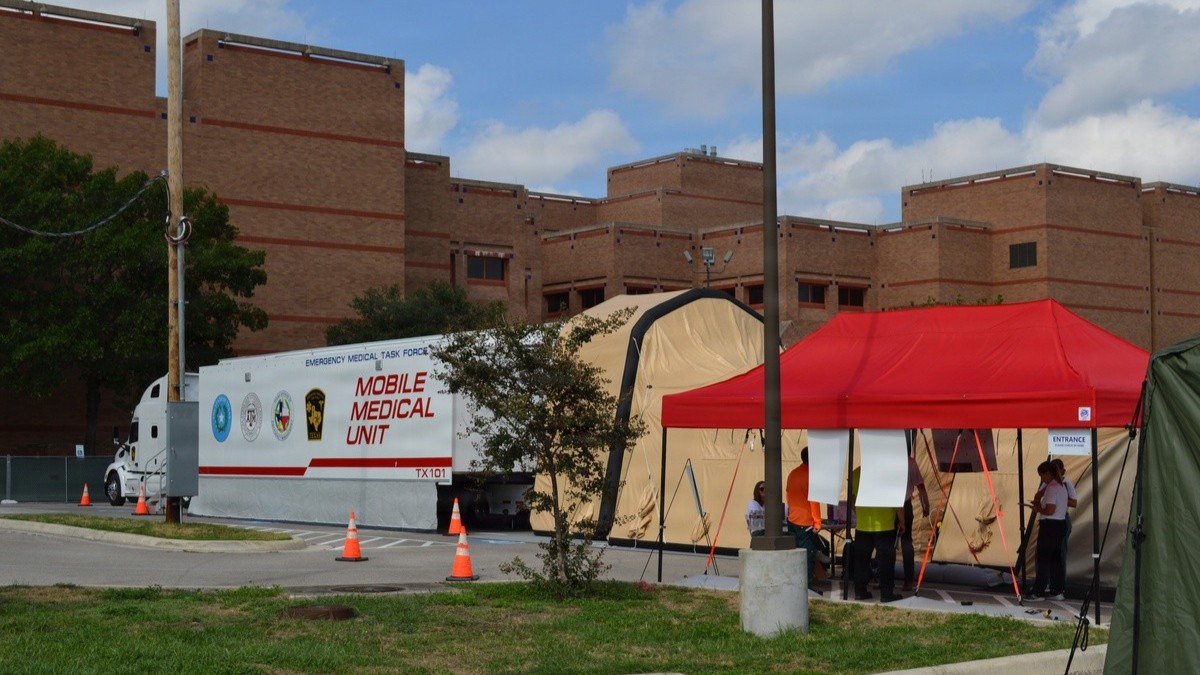
The NDMS Modular/Convertible Capability Pilot connects both hard and soft sided components from multiple vendors into one comprehensive Hospital Expansion Solution to validate the integration feasibility and gather insights to incorporate into HXS design and operation guidelines.
Laura Baker, the project program manager for the NDMS modular program from Deloitte, said their role was to work with the DHA to address the congressional question, “Are we ready for a major medical surge following a LSCO (Large-Scale Combat Operations) event?”
“We're actually in year two of the rapid prototype project,” Baker said. “Year one, we went through the design phase trying to understand what was needed to make an integrated solution that works with a hospital to bring their staff and their patients out of their facility. We are now in the end of year two. This is our big site field test where we're really putting everything together on the ground and understanding and seeing how it works.”
“We've identified that about 20% bed capacity expansion is kind of that sweet spot, probably about a maximum actually,” Bullock said. “We envisioned this as an overflow area, not a primary care area.”
Over a two-day period, more than 200 BAMC medical, facilities management, safety, environmental services, IT, emergency management and security personnel toured the modular structure and provided feedback about its design and capabilities. “I think from a BAMC perspective, it’s all about readiness,” said Army Col. Jason Williams, BAMC deputy director and deputy commanding officer. “It’s always about taking care of your people. It’s amazing to see the structure, to see the capability, the interoperability across the board.”
Now the team will consolidate what they learned and work to create a manual that hospitals can use to develop their own plans on how they can expand their own capabilities. “The tool is based to support hospitals in how they can manage expanding their bed capacity,” Bullock said. “It's an individual solution. We don't tell them what the package is, we just tell them these are the things we found that would be workable. Here's the things you have to consider, cost, space, resources within the community, those kinds of things.”
“We are very fortunate that DHA picked BAMC for this mission,” said Army Lt. Col. Gary Legault, officer in charge of the event. “BAMC was an excellent selection for this exercise. As the only Level 1 Trauma Center in the Department of War we have the experts that can support this, come provide feedback and guide it.”
Williams praised the entire team for their efforts in planning and executing the event. “I think it was pretty impressive across the board,” he said.